


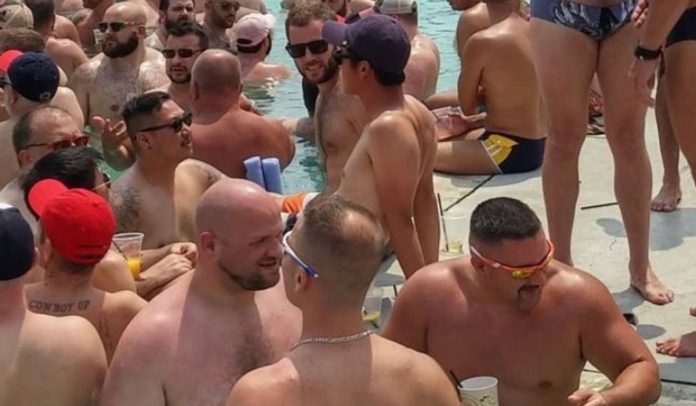

The bears aren’t disappearing.
But apparently they’re ordering smaller T-shirts.
That was one of the more fascinating details to emerge from a recent Advocate look at how GLP-1 weight-loss medications are affecting gay bear culture.
Frank Mahoney, president of the Provincetown Bears, said registrations for this summer’s Bear Week were running ahead of the previous year.
So much for the extinction of the bear.
But organizers had noticed something else.
Where larger T-shirt sizes once dominated orders, more attendees were requesting small, medium and large.
It’s a wonderfully mundane detail that hints at a much bigger cultural question.
What happens to bear culture when the bears start losing weight?
More Than A Body Type
Bear culture emerged within gay male culture in the 1980s, partly as an alternative to beauty standards that often privileged youth, thinness and carefully sculpted bodies.
Academic research into bear identity has found that bigger and hairier bodies became not merely accepted within the community, but desirable.
For some men, discovering bear culture meant discovering that characteristics they had been taught to dislike about themselves could actually make them attractive.
That can be enormously powerful.
But it also helps explain why Ozempic, Wegovy, Mounjaro, Zepbound and similar medications have created such an interesting conversation.
Some bear-identified men are now losing substantial amounts of weight.
Some use these medications to treat diabetes or other medical conditions.
Some want to lose weight for other health reasons.
And some simply want a different body.
None of those men should have to justify that decision to the rest of us.
Can You Lose The Belly And Keep The Bear?
Richard Jones of Bear World Magazine has lost weight while using Mounjaro to manage type 2 diabetes.
He still considers himself a bear.
And perhaps that shouldn’t be surprising.
Bear culture has never had an official weigh-in.
Its sprawling vocabulary alone — bears, cubs, otters, muscle bears, polar bears and plenty more — suggests a community that has always contained different bodies.
Research has also described bear identity as involving belonging, masculinity, maturity and self-acceptance rather than simply physical measurements.
A man’s body can change enormously between 30 and 60 without his friends, relationships or sense of community disappearing with his waistline.
So why should losing weight automatically revoke his bear card?
But What About The Chasers?
There is, naturally, another constituency in this debate.
The men who really, really like bears. 🐻❤️
If bigger bodies are genuinely part of what attracts you to someone, watching those bodies shrink may produce some complicated feelings.
Hence the jokes about Ozempic making the bears disappear.
But there is an important line between attraction and ownership.
Nobody owes a boyfriend, a hookup, a dating app or an entire gay subculture a particular body.
A man choosing to lose weight isn’t betraying people who find larger men attractive.
Equally, a man choosing not to lose weight shouldn’t be treated as somebody waiting to be “fixed.”
That may be where this supposedly silly question becomes genuinely interesting.
Body Acceptance Has To Work Both Ways
Bear culture’s most valuable contribution may never have been convincing gay men that bigger bodies were better.
It was showing many men that bigger bodies could be attractive at all.
That distinction matters.
Body acceptance stops being acceptance if it requires somebody to preserve the same body forever.
And bear culture itself has never been as simple as fat men with beards.
Not every bear is large.
Not every large gay man identifies as a bear.
Not every bear is hairy.
And the community has never been completely free from its own arguments about who is bearish enough to belong.
GLP-1 medications haven’t created those questions.
They’ve simply given the community a new reason to ask them.
So Where Are All The Bears Going?
Judging from Provincetown, nowhere.
They’re still going to Bear Week.
They’re still finding one another.
They’re still building friendships, having sex, falling in love, dancing, partying and creating community.
Some of them may simply be doing it in smaller T-shirts.
And perhaps that tells us something important about what bear culture became after decades of existence.
It may have started partly around bodies that mainstream gay culture failed to appreciate.
But somewhere along the way, it became bigger than those bodies.
Maybe GLP-1s aren’t killing bear culture at all.
Maybe they’re revealing what was underneath the belly all along.
A community.
📷 @ptownbears
🎬 Prefer video? Subscribe to B-Gay on YouTube: https://youtube.com/@BGaycom