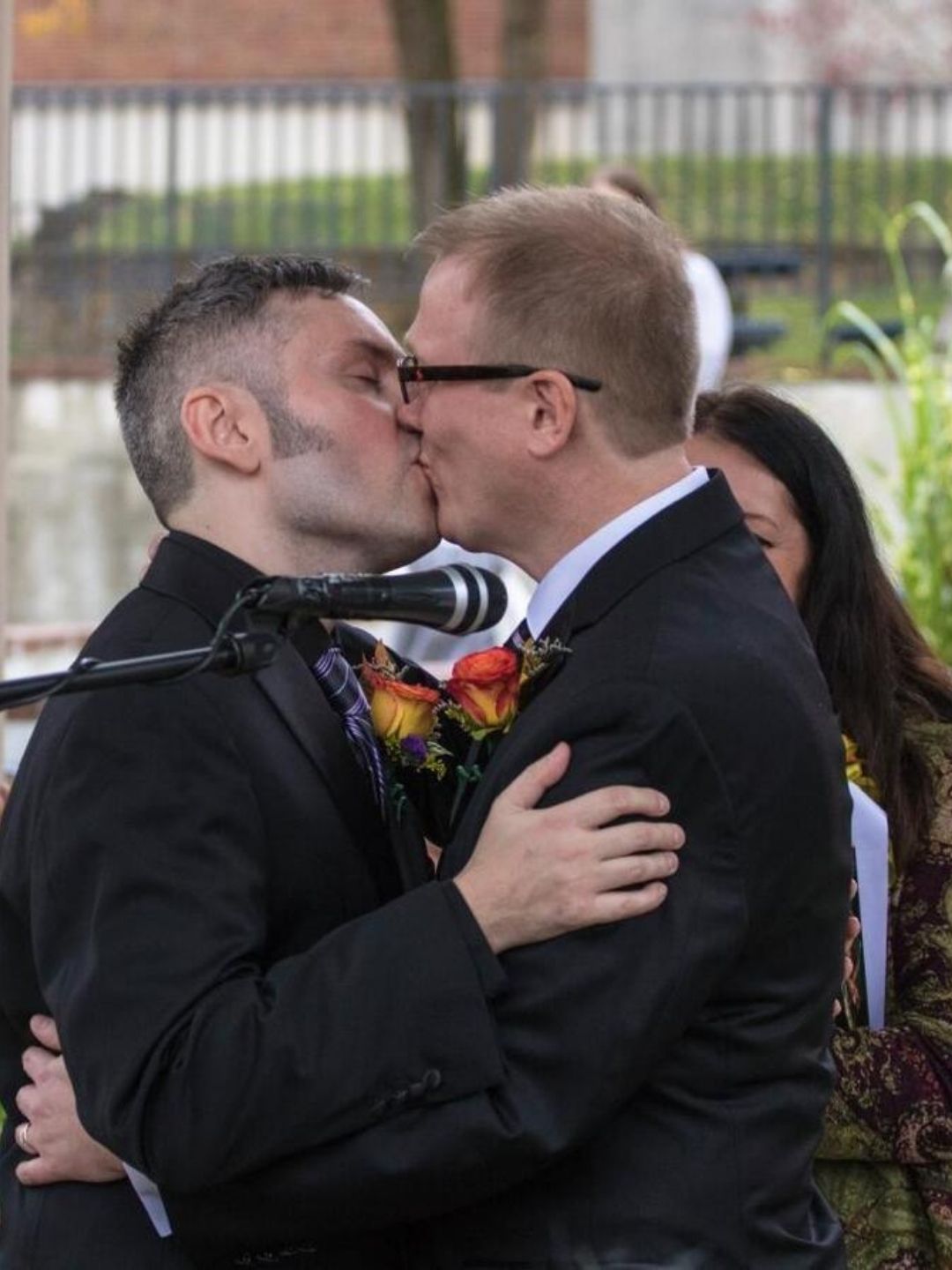


Dan Mackey turns a painful coming-out letter into lasting queer art

Brighton-based artist Dan Mackey has been shortlisted for the Royal Academy Summer Exhibition 2026 with one of his most personal works yet.

The piece is a ceramic recreation of the coming-out letter he wrote to his mother in 2007 when he was 20 years old and in what he has described as a very dark place in his life.

That alone would make it moving.

But what gives the work even more resonance is the way it captures a moment many LGBTQ+ people will immediately understand.

It is not polished, staged, or sentimental.

It is direct, frightened, and honest.

In the letter, Mackey tells his mother that he is writing things down because he is scared she will be disappointed in him and change how she feels toward him.

He also writes that being gay is not something he would choose, but something he has to admit if he wants to be happy with himself.

That kind of language will feel painfully familiar to many queer people who grew up trying to manage other people’s expectations while barely understanding how to live with themselves.

Mackey has said that reading his old diaries now is difficult because they take him back to a time when he felt lonely, unhappy, and increasingly cut off from other people.

He described spending more time alone, growing apart from friends, and writing about hating himself and his life.

By turning that memory into ceramic, he has given it a different kind of permanence.

The material matters here.

Ceramic is heavy, tactile, and lasting, and Mackey has said he wanted the piece to feel physically the way that moment felt emotionally.

That choice makes the work more than a recreation of a letter.

It becomes a record of emotional weight.

It also turns a private act of fear into something public, visible, and shared.

The fact that the work has now been shortlisted for the Royal Academy Summer Exhibition gives that private history an even wider cultural frame.

The exhibition is one of the best-known open-submission art shows in the world, and Mackey’s inclusion places a deeply queer, deeply personal story inside one of Britain’s most established art institutions.

That feels significant in itself.

It suggests that queer life is not only worthy of representation, but of preservation.

There is also something especially affecting about where Mackey’s life stands now.

He is married to Adam Johnson, and the couple’s 2023 wedding became part of the BBC documentary Big Gay Wedding with Tom Allen.

That detail adds a quiet full-circle quality to the story.

The same person who once wrote a frightened letter to his mother is now living openly, building a creative career, and seeing his work recognized on one of the biggest stages in British art.

Mackey has also said that his relationship with his mother is strong today, and that coming out was only one part of a much larger story between them.

That matters too.

Too many coming-out narratives end at the point of confession, as if the hardest sentence is the whole story.

Mackey’s work reminds us that it is only the beginning.

What follows can include distance, healing, love, art, and a life that once seemed impossible.

That is part of what makes this piece feel so powerful.

It preserves not only fear, but survival.

And in doing so, it turns one young man’s private pain into a lasting piece of queer history.

📷 IG: @ danmakeystuff

Jacob Tierney’s new Netflix series about Alexander the Great already has a queer vibe

0

Jacob Tierney, the creator behind Heated Rivalry, is developing a new Netflix historical drama titled Alexander, and it already feels like a project queer audiences will want to watch closely.

According to Netflix, the series is based on Annabel Lyon’s acclaimed novel The Golden Mean and centers on the relationship between the young Alexander and his tutor Aristotle in ancient Macedonia.

That premise alone makes the project more interesting than a standard sword-and-sandals retelling.

Lyon’s novel is not simply about conquest or battlefield glory.

It is a character-driven story about power, mentorship, intellect, desire, pressure, and the emotional formation of one of history’s most mythologized men.

Netflix’s own language suggests the adaptation will lean into that complexity.

The streamer has described the series as unfolding amid palace intrigue, forbidden love, war, and ambition, which immediately gives the project a more intimate and emotionally charged frame than many traditional Alexander narratives.

That matters for queer audiences because Alexander the Great has long occupied a fascinating place in queer historical imagination.

Historians have debated his sexuality for generations, and while modern identity labels do not map neatly onto the ancient world, Alexander’s bond with Hephaestion has often been read as romantic, erotic, or at the very least exceptionally intimate.

Britannica describes Hephaestion as Alexander’s closest friend, and Alexander’s grief after his death has often been cited as evidence of the extraordinary depth of that relationship.

In other words, this is not a random modern attempt to impose queerness onto a historical figure.

The questions surrounding Alexander’s relationships with men have been part of his story for a very long time.

That does not necessarily mean the new Netflix series will be explicitly gay in the way Heated Rivalry is.

But it does mean the material naturally sits inside a space where queer readings are not only possible, but deeply embedded in how audiences and writers have approached Alexander for years.

Tierney’s involvement makes that even more notable.

He is already associated with emotionally intense storytelling about male relationships, longing, and vulnerability.

That does not guarantee a romance-centered Alexander series, but it does make it easier to imagine a version of this story that pays real attention to intimacy rather than treating it as background decoration.

There is also something compelling about the source material itself.

The Golden Mean has been praised as a bold reimagining of the relationship between Aristotle and Alexander, and its appeal lies less in historical pageantry than in psychological tension and human messiness.

That is often where the most resonant queer historical storytelling lives.

It connects a creator already known to queer audiences with a major Netflix platform, a literary source with emotional depth, and a historical figure whose life has long generated queer curiosity.

Even before casting news arrives, the ingredients are there.

This may turn out to be a prestige historical drama first and a queer-interest title second.

But it would be hard to argue that queer viewers will not be paying attention.

And if Netflix really does lean into the “forbidden love” part of its own description, this could become one of the more intriguing gay-adjacent historical projects on the streamer’s slate.

Note! Article image is AI and only represent how I imagine the new series 😁

ABC Renews ‘9-1-1’ for Season 10 — And Fans Are Already Talking About Buck and Eddie

0

ABC has officially renewed 9-1-1 for a tenth season, ensuring that the long-running first responder drama will continue into the 2026–27 television season.

The network also confirmed that the franchise’s expansion will continue, with 9-1-1: Nashville returning for a second season after establishing itself as a new branch of the emergency-services universe.

Since its debut in 2018, 9-1-1 has followed the high-stakes professional and personal lives of Los Angeles first responders, combining intense rescue sequences with character-driven storytelling.

The series has consistently performed well in ratings and streaming metrics, making it one of ABC’s most dependable drama properties.

But beyond the emergencies and dramatic rescues, another storyline has quietly built one of television’s most dedicated fan communities.

The relationship between firefighters Evan “Buck” Buckley and Eddie Diaz — played by Oliver Stark and Ryan Guzman — has become one of the most discussed dynamics in the show’s history.

Over the years, fans have coined the nickname “Buddie” for the potential pairing, imagining the two characters as something more than close friends and partners at Station 118.

The speculation gained new momentum when Buck came out as bisexual in the show’s milestone 100th episode.

For many viewers, the moment felt like a meaningful step forward in the series’ representation of queer characters.

While the show has not confirmed any romantic storyline between Buck and Eddie, the emotional closeness of the characters has kept audiences invested.

The two firefighters share a deep bond that has developed through years of shared trauma, family struggles, and life-or-death rescues.

Their connection has often been portrayed with an intimacy that fans say feels unique among television friendships.

Scenes involving Eddie’s son Christopher, who shares a particularly strong relationship with Buck, have only strengthened the sense that the characters’ lives are closely intertwined.

For supporters of the Buddie theory, every new season represents another opportunity for the story to evolve.

Even when the show focuses primarily on friendship, the chemistry between the actors continues to fuel speculation online.

Fan edits, discussions, and theories have become a regular feature of the show’s social media ecosystem.

The renewal of 9-1-1 therefore means more than just another season of dramatic emergencies.

For many viewers, it also means more time to watch how Buck and Eddie’s relationship develops.

Whether the series ever moves in a romantic direction remains an open question.

But with a tenth season now confirmed, one thing is certain.

The story of Station 118 — and the connection at the heart of its most talked-about friendship — is far from over.

📷 IG: @ 911onABC

Rob Jetten sworn in as Dutch prime minister in historic moment for LGBTQ+ visibility

0

Rob Jetten was sworn in on February 23, 2026, becoming the Netherlands’ youngest-ever prime minister and its first openly gay leader.

The inauguration marked a new chapter in Dutch politics, with Jetten taking office at 38 and stepping into a job that will require constant coalition-building from day one.

His government is a rare minority coalition made up of D66, the Christian Democrats, and the VVD, holding just 66 of 150 seats in the lower house.

That parliamentary math means Jetten will need opposition support to pass legislation, making negotiation and consensus not just ideals, but basic operating requirements.

Internationally, the new prime minister has signaled a pro-European approach and continued alignment with key allies, while facing a polarized domestic environment shaped by recent political turbulence.

For LGBTQ+ audiences, though, the significance of the moment is not only procedural but cultural, because it places an openly gay man at the symbolic center of national leadership in a major European democracy.

Jetten has been publicly out for years, and his ascent has unfolded without the hedging and coded language that still surrounds queer identity in many political cultures.

That authenticity has also been visible in his private life, particularly through his relationship with Nicolás Keenan, his fiancé and a prominent elite athlete.

Keenan is an Argentine field hockey player who has competed at the Olympics and built a reputation as one of the most visible out LGBTQ+ men in his sport.

The couple announced their engagement in November 2024, sharing their news publicly and framing it with the kind of normal, joyful confidence that still lands as meaningful representation.

In a world where politics and public life often demand strategic concealment, their relationship has been presented as neither a campaign tactic nor a spectacle, but as a real partnership that exists in plain sight.

That visibility matters because leadership is partly about who society imagines as “possible” at the top, and queer people are still too often treated as exceptions rather than part of the mainstream story.

Jetten’s swearing-in does not magically resolve debates about rights, safety, or social backlash, and the Netherlands, like every country, still contains political forces that resist inclusion.

But the image of an openly gay prime minister taking the oath, while openly planning a life with his fiancé, shifts the cultural baseline in a quiet and durable way.

It also creates a new point of reference for young queer people watching from the Netherlands and beyond, especially those who rarely see public power paired with visible queer adulthood.

For Jetten, the test now is governance, because history books may note the milestone, but voters will judge whether his minority cabinet can deliver stability and results.

Still, moments like this land on more than one level at once, because they carry the practical weight of statecraft and the human weight of representation.

And for many LGBTQ+ readers, it is hard not to see it as a full, modern picture of public life, where competence and queerness are no longer treated as contradictory truths.

📷 IG: @ jettenrob / nicokeenan

Bruce Mouat leads Team GB to Olympic silver after a tight 9–6 final loss to Canada

0

Great Britain’s men’s curling team came painfully close to Olympic gold, but had to settle for silver after a tense 9–6 loss to Canada in the Milano Cortina 2026 final.

Skip Bruce Mouat, alongside Grant Hardie, Bobby Lammie, and Hammy McMillan, pushed Canada deep into the match before the final ends swung decisively the other way.

The scoreline looks clear, but the contest wasn’t, with momentum shifting end by end and pressure building with every stone.

The turning point arrived late, when Canada capitalised on British errors to score three in the ninth end and put a grip on the game that never really loosened.

Canada then closed it out with a steal in the tenth, sealing gold and leaving Team GB with the familiar sting of finishing second on the sport’s biggest stage.

For Mouat, it’s a second consecutive Olympic silver after Beijing 2022, an outcome that hurts in the moment but also underlines how consistently elite this rink has become.

Team GB arrived with the weight of expectation after a dominant season that marked them as one of the pre-tournament favourites, and they largely played like it until the very end.

Canada’s skip Brad Jacobs framed the victory as a statement performance, especially after his team dealt with distracting controversy earlier in the tournament.

In Reuters reporting, Jacobs described accusations from Sweden about cheating during round-robin play as outrageous, and said the noise only sharpened Canada’s determination to prove themselves.

That edge showed when it mattered, because Canada stayed clinical under pressure and made the late-game calls that separate finalists from champions.

For British fans, this is also the story of a team that keeps showing up in the medal matches and making the sport feel urgent again back home.

It’s hard not to view Mouat’s leadership as part of that shift, because he brings a calm, modern confidence that fits the way curling is evolving on the global stage.

Mouat’s visibility matters too, as an openly gay Olympian competing in one of the Winter Games’ most tactically intense events while keeping his focus squarely on performance.

He has spoken publicly about being out and the importance of honesty within a team environment, and he lives in Scotland with his boyfriend Craig Kyle.

Moments like this still matter, because seeing queer athletes in high-stakes finals normalises excellence rather than turning identity into a storyline that has to be explained.

Silver is not what Team GB wanted, but the medal still lands as proof of sustained greatness, and the kind of platform that can inspire the next generation of curlers watching at home.

📷 IG: @ brucemouat / craig_thebagel