


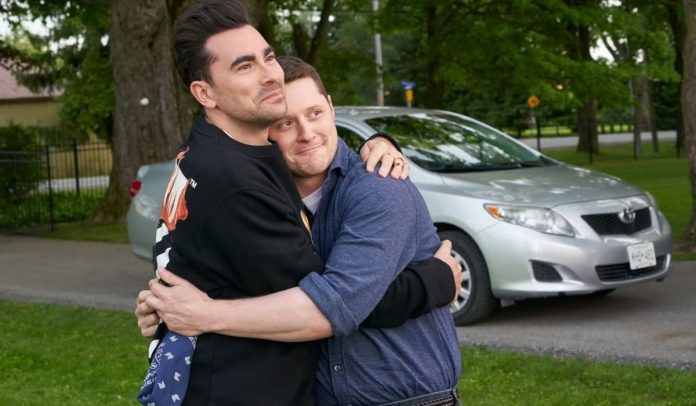

David Rose and Patrick Brewer gave gay men something television had rarely allowed them to have: a love story that did not need to fight for permission to exist.
Dan Levy, who turns 43 today, did not create Schitt’s Creek as a show about LGBTQ+ rights.

He created a comedy about a wealthy family losing everything and being forced to rebuild their lives in a small town they once purchased as a joke.
Yet within that ridiculous premise, Levy made one of the most quietly radical decisions in modern television.
He imagined a community where homophobia was not part of the story.
David’s sexuality mattered.
His relationship with Patrick mattered.
But nobody in Schitt’s Creek needed to punish them for it.
There was no hateful neighbour trying to close their business.
No parent rejecting a gay son.
No town controversy surrounding their wedding.
No storyline insisting that queer love had to suffer before viewers would consider it meaningful.
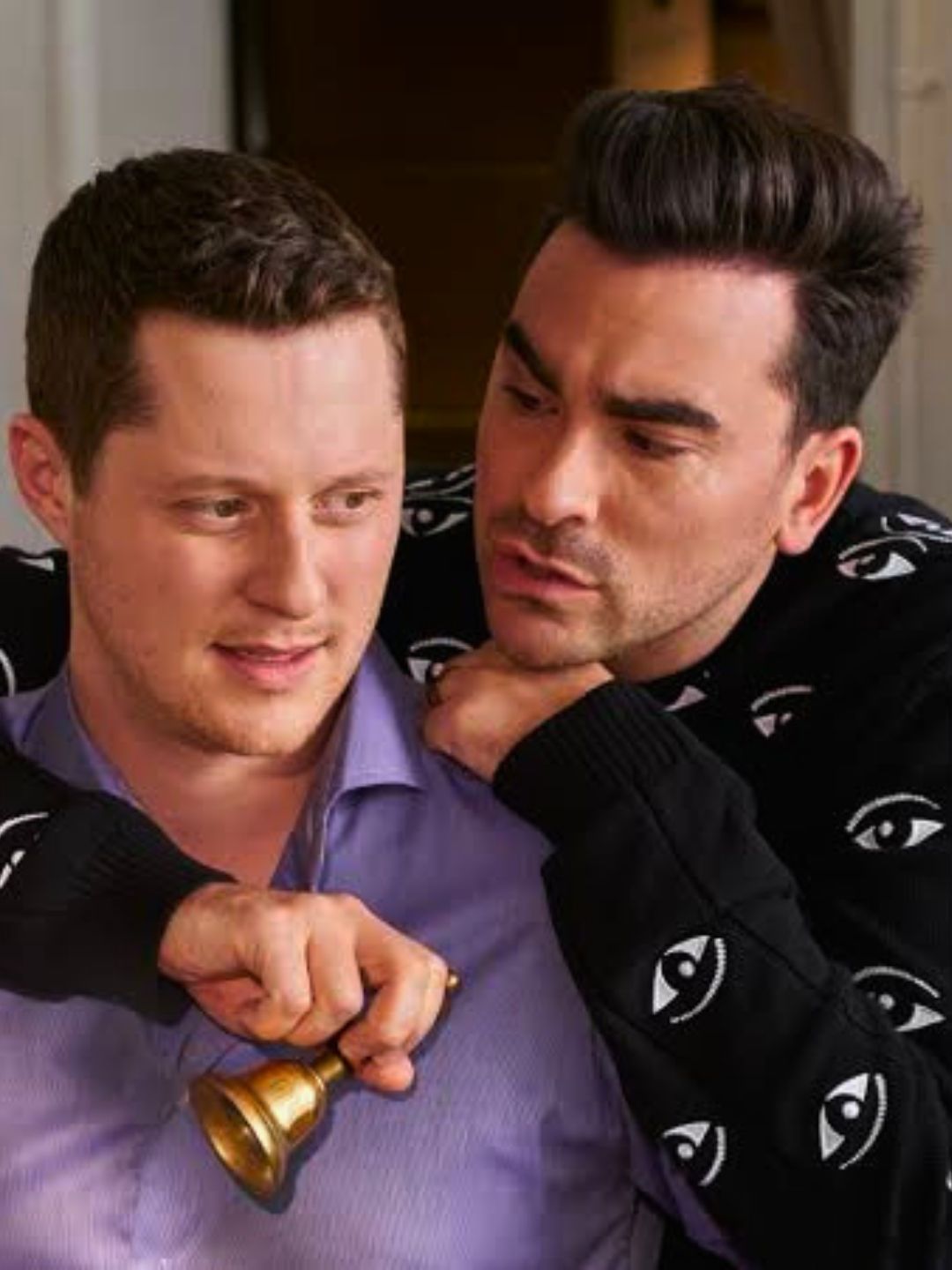
David and Patrick were allowed to have the problems television had long reserved for straight couples.
They could be awkward.
Jealous.
Insecure.
Romantic.
Sexual.
Occasionally selfish.
And completely in love.
The Stories Gay Men Had Been Given
For decades, many of television’s most important gay male stories were built around conflict.
Coming out often meant rejection.
Love meant secrecy.
Sexuality meant shame, discrimination or violence.
During the AIDS crisis, gay male characters were frequently introduced through illness, death or the fear they inspired in others.
Those stories mattered because they reflected realities many gay men were living.
Pedro Zamora and Sean Sasser, whose relationship appeared on MTV’s The Real World: San Francisco in 1994, showed millions of viewers that two men living with HIV could date, kiss, support each other and exchange vows.
Their visibility was extraordinary precisely because mainstream television offered so few images of loving male couples.
Later programmes opened more doors.
Will & Grace brought gay leading characters into American homes every week.
Queer as Folk allowed gay men to be sexually explicit, complicated and unapologetic.
Other dramas explored coming out, family rejection, HIV, discrimination and the search for acceptance.
But even sympathetic queer stories were often structured around a familiar question.
Would the gay character be allowed to exist?
Schitt’s Creek asked something different.
What happens after nobody objects?
David Rose Was Never Required to Explain Himself
David Rose enters the series as anxious, dramatic, exquisitely dressed and difficult to categorise.
Viewers might initially assume he is gay.
Levy deliberately complicated that assumption.
David is pansexual.
He has relationships with both men and women, and his sexuality is explained through one of the show’s most famous metaphors.
When Stevie asks whether he drinks red wine or white wine, David explains that he likes the wine rather than the label.
The scene is funny, clear and remarkably relaxed.
David does not need a dramatic confession.
He does not gather his family to reveal a secret.
His parents do not struggle to accept him.
His sexuality is simply one part of who he is.
Levy told Them that he wanted to challenge assumptions viewers might make about David based on his appearance and mannerisms.
That choice mattered because LGBTQ+ representation can become restrictive even when it is positive.
A flamboyant man is assumed to be gay.
A masculine man is assumed to be straight.
A bisexual or pansexual person is treated as confused or temporarily undecided.
David resists those categories without the show turning his identity into a lesson.
Then Patrick Brewer walks into Rose Apothecary.
The Man Behind the Business Licence
Patrick first appears during the third season when David needs help applying for a business licence.
Their initial interactions contain the familiar awkwardness of two people who are attracted to each other before either is entirely sure what is happening.
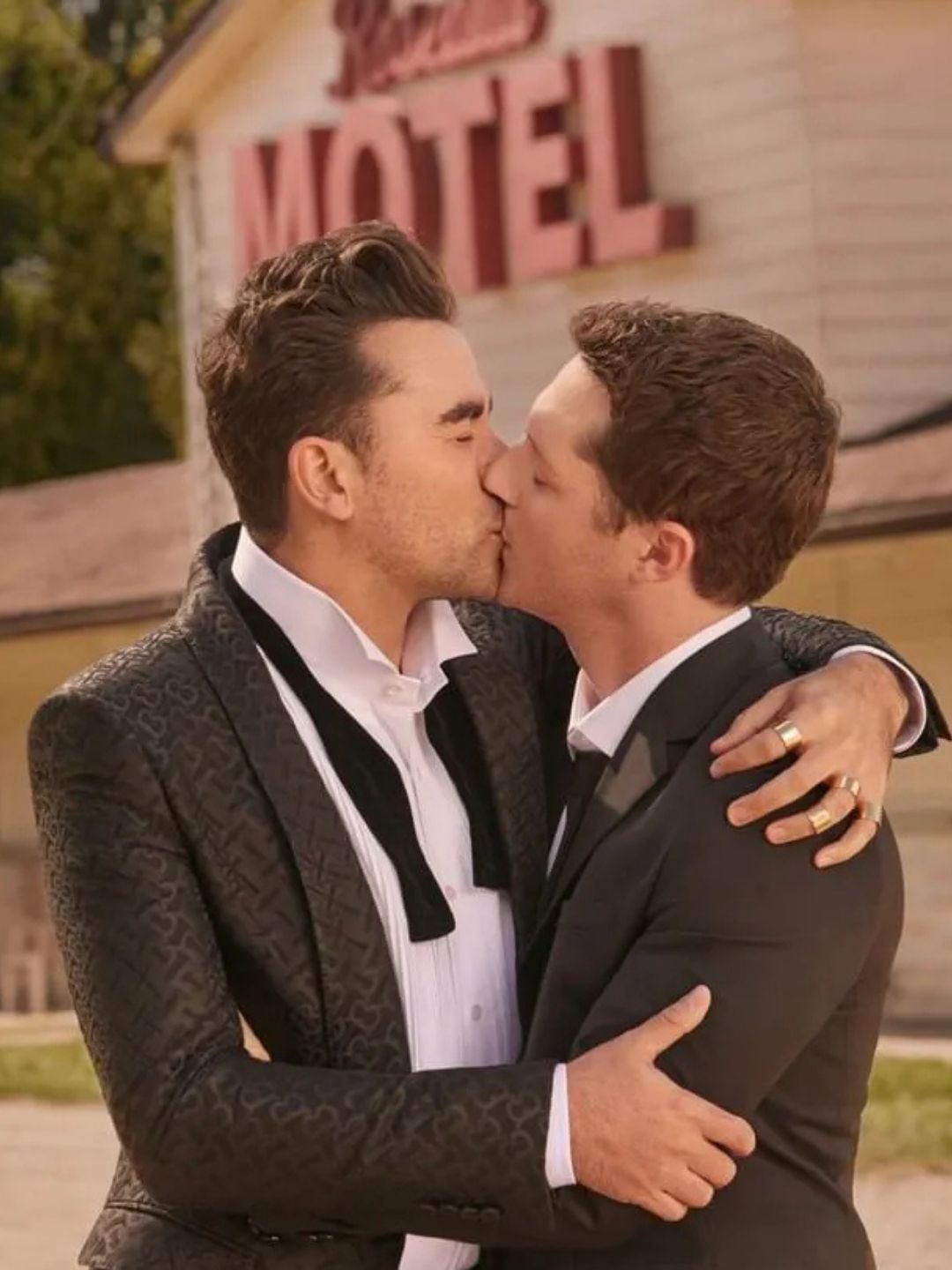
Patrick is patient, practical and quietly amused by David.
David is defensive, intrigued and increasingly unable to pretend the relationship is purely professional.
Patrick eventually becomes David’s business partner at Rose Apothecary.
Then he asks him out.
Their first kiss arrives without a dramatic threat surrounding it.
Patrick is nervous because he has never kissed another man before.
David responds not with panic or judgement, but tenderness.
Patrick’s discovery of his sexuality is significant, but it does not destroy his life.
He is allowed uncertainty without being punished for it.
David is allowed to guide him without becoming a tragic mentor.
The relationship develops through conversation, attraction and shared work rather than through a crisis manufactured around their queerness.
That may sound ordinary.
Ordinary was the breakthrough.
A Love Story With Different Problems
The absence of homophobia did not make David and Patrick’s relationship free of conflict.
It created room for more interesting conflict.
David struggles to trust that someone as grounded as Patrick could genuinely want him.
Patrick withholds parts of his past.
Former relationships complicate their new one.
They misunderstand each other.
They occasionally cause pain.
David’s insecurity does not disappear simply because he has found a kind man.
Patrick’s calmness does not mean he always knows what to do.
They have to learn how to communicate, compromise and believe in what they are building.
In other words, they receive a relationship rather than a representation exercise.
David can be selfish without his flaws being attributed to his sexuality.
Patrick can make mistakes without his identity becoming a cautionary tale.
Their love is specifically queer, but it is never reduced to queerness.
That balance is one of the reasons the relationship has remained so meaningful to viewers.
“Simply the Best”
One of the defining moments in David and Patrick’s relationship takes place during an open-mic night at Rose Apothecary.
Patrick stands in front of the town and performs an acoustic version of Tina Turner’s “The Best.”
David watches from the audience.
His usual sarcasm and self-protection begin to fall away.
Catherine O’Hara’s Moira watches her son watching Patrick and realises how deeply he is loved.
Nothing threatening happens.
Nobody mocks the man singing to his boyfriend.
The scene is allowed to be openly romantic.
Later, David returns the gesture by lip-syncing and dancing to the same song for Patrick.
His performance is ridiculous, vulnerable and completely sincere.
Television had often allowed gay men to be funny.
It had often allowed them to be stylish, witty or emotionally wounded.
David and Patrick were allowed to be romantic without the show apologising for it.
Patrick Comes Out to His Parents
The series does eventually include a coming-out storyline.
Patrick has not told his parents about David.
When they arrive unexpectedly, David worries that his presence may force Patrick into a conversation before he is ready.
The setup resembles countless television stories in which queer characters prepare for rejection.
Patrick is frightened.
David becomes protective.
The audience braces for pain.
But Patrick’s parents are not angry that their son loves a man.
They are upset because they fear Patrick believed he could not tell them.
Their concern is not that he is gay.
It is that they may somehow have made him feel unsafe.
The episode acknowledges the emotional weight of coming out without using parental cruelty as its inevitable conclusion.
That distinction offered many viewers an image they had rarely seen.
A queer child’s fear could be real even when rejection did not follow.
Coming out could produce relief rather than exile.
A family could respond by asking how to love better.
The World Without Homophobia Was Deliberate
The absence of anti-gay prejudice in Schitt’s Creek was not an accidental omission.
Levy made a conscious creative choice.
He told WBUR that leaving homophobia out of the show was deliberate because audiences can learn from seeing a better reality presented naturally rather than being explicitly lectured.
In another interview, Levy said he had no patience for homophobia and wanted the show to foreground love and tolerance instead.
The decision was not an argument that prejudice had disappeared from the real world.
Levy knew that LGBTQ+ people continued to face rejection, discrimination and violence.
He chose not to reproduce that suffering inside every queer story he told.
That distinction is important.
Representation does not become dishonest simply because it imagines something better.
Stories can reflect injustice.
They can also model freedom.
Schitt’s Creek showed viewers a town where David and Patrick’s love required no political debate.
The audience was invited to accept that world not through speeches, but through familiarity.
Episode after episode, the relationship simply continued.
What the Absence Made Possible
Removing homophobia from the story did not remove emotional depth.
It changed where that depth could come from.
David’s central fear was not that the town would reject him for loving Patrick.
It was that Patrick might eventually discover David was too difficult to love.
That fear grew from David’s personal history, insecurity and tendency to protect himself through sarcasm.
Patrick’s journey was not primarily about surviving prejudice.
It was about understanding himself, communicating honestly and choosing the life he wanted.
Once the show stopped asking whether two men deserved a relationship, it could explore what sustaining that relationship actually required.
They supported each other’s ambitions.
They navigated money, business and family.
They discussed sex.
They disagreed about where to live.
They imagined a future together.
Gay viewers were not merely being shown that people like them existed.
They were being shown that their lives could contain ordinary complexity.
The Proposal
Patrick proposes during a hike in the fifth season.
The journey does not go smoothly.
David complains.
Patrick injures his foot.
The romantic setting Patrick has planned appears increasingly unlikely to survive the reality of being with David Rose.
Then they reach the viewpoint.
Patrick asks David to marry him.
The proposal is heartfelt without becoming detached from the comedy of who these characters are.
David remains David.
Patrick loves him not despite that fact, but with full knowledge of it.
The engagement is celebrated by their families and friends.
There is no debate about whether two men should marry.
The only concern is how David will manage the wedding planning without driving everyone around him insane.
The Wedding
The series ends with David and Patrick’s wedding.
Rain destroys David’s carefully planned outdoor ceremony.
The officiant cancels.
The family scrambles to rescue the day.
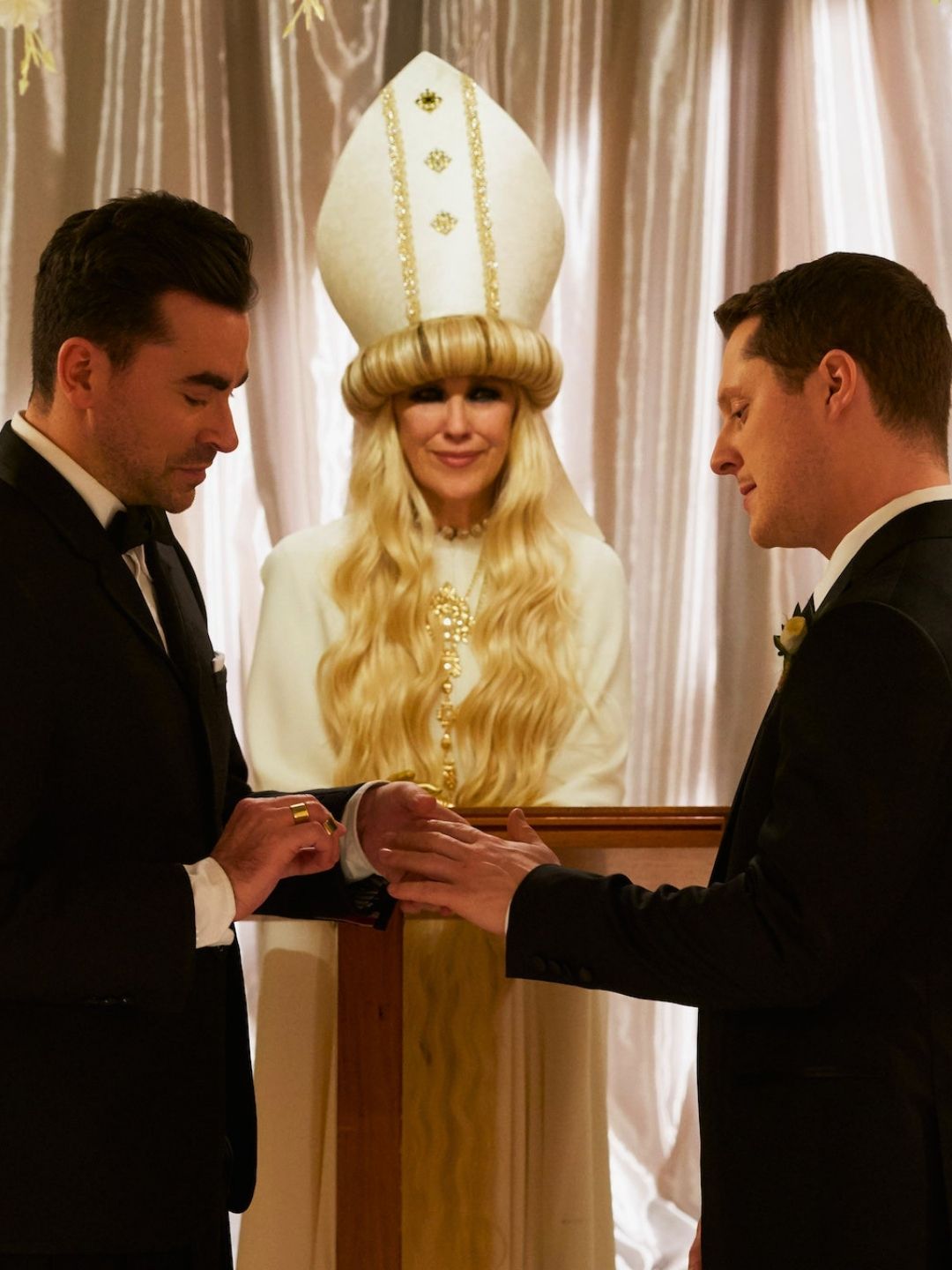
Moira conducts the ceremony in one of the most extraordinary outfits ever worn by a television mother.
Alexis walks David down the aisle.
The Jazzagals sing.
Patrick incorporates Mariah Carey into his vows.
David and Patrick marry surrounded by the people who love them.
The finale does not treat the wedding as a political statement inside the story.
That is what makes it political outside the story.
A gay wedding becomes the emotional conclusion of a mainstream comedy without anyone needing to defend it.
The audience is not asked whether the marriage should happen.
It is asked to care whether the rain will ruin David’s decorations.
Levy told Vanity Fair that the ceremony deliberately wove together musical and emotional references from David and Patrick’s relationship.
The wedding felt earned because viewers had watched the couple build towards it over several seasons.
A Political Statement Made Through Joy
Schitt’s Creek rarely sounded like an activist campaign.
It made its argument through joy.
David and Patrick did not need to be perfect representatives of queer life.
They only needed to be treated with the same emotional generosity television had long given heterosexual couples.
The show trusted audiences to recognise their love without translating it into a social issue.
That trust had consequences.
Levy has spoken about letters from families who watched the programme together and found that it changed conversations inside their own homes.
Some parents said the relationship helped them better understand their LGBTQ+ children.
Other viewers said David and Patrick made queer love feel familiar rather than threatening.
The show did not achieve that by presenting a debate and declaring one side correct.
It allowed viewers to spend time with the couple.
Familiarity did the work.
Not the First, but Still Transformative
Schitt’s Creek did not invent positive LGBTQ+ representation.
David and Patrick were not television’s first loving male couple.
Many queer creators and performers had already pushed boundaries, often at considerable personal and professional risk.
The importance of David and Patrick lies in the particular freedom they received.
Their story did not need to justify itself through suffering.
They were allowed happiness without becoming shallow.
They were allowed conflict without becoming tragic.
They were allowed sexuality without shame.
They were allowed marriage without controversy.
Earlier LGBTQ+ stories had fought to make gay men visible.
David and Patrick helped demonstrate what television could do once visibility was no longer the only goal.
Why Gay Men Responded So Deeply
For many gay viewers, the relationship touched something personal.
Some had grown up expecting love to come with secrecy or loss.
Some had watched characters like them die, disappear or remain permanently alone.
Some had learned to approach happiness cautiously because positive queer stories often seemed to be preparing for tragedy.
David and Patrick invited those viewers to relax.
Not because nothing painful would ever happen.
But because pain was not presented as the inevitable price of being queer.
The couple could have a happy episode without audiences waiting for a homophobic attack to interrupt it.
They could discuss marriage without the law becoming the plot.
They could imagine growing old together.
That possibility can feel ordinary to people who have always seen their relationships reflected on screen.
For many gay men, it felt like receiving something television had withheld.
A World Worth Imagining
Critics sometimes describe the town of Schitt’s Creek as unrealistic because nobody appears to be homophobic.
That criticism misunderstands what fiction can do.
The town was never intended as a documentary portrait of every small community.
It was an imaginative choice.
Levy removed one familiar source of cruelty and asked what kinds of stories could grow in the space left behind.
The answer was not a perfect world.
The people of Schitt’s Creek remain vain, misguided, intrusive and frequently ridiculous.
They simply do not regard queer love as a problem.
That single adjustment changes everything.
David does not need to become braver by surviving hatred.
Patrick does not need to earn acceptance.
Their families do not need to overcome prejudice before joining the celebration.
The story begins from the assumption that their love belongs.
The Gift Dan Levy Gave Television
Dan Levy’s birthday gives us an excuse to celebrate his work.
But the lasting achievement of David and Patrick deserves more than a birthday tribute.
Levy gave viewers a queer relationship that was not defined by the hostility surrounding it.
He allowed two men to flirt, fail, forgive, desire, support and commit to one another.
He gave David Rose something gay characters had often been denied.
Not merely acceptance.
A full romantic life.
The significance was not that David and Patrick never experienced difficulty.
It was that their difficulty did not come from a world insisting they should not be together.
They could face the same terrifying question that confronts anyone who falls deeply in love.
Can I trust another person with the most vulnerable parts of myself?
For once, television allowed two queer men to answer that question without first asking whether their love had a right to exist.
Simply Love
Yesterday, we remembered Pedro Zamora and Sean Sasser showing America two men falling in love during the AIDS crisis.
Their visibility helped make later stories possible.
More than two decades afterwards, David and Patrick showed audiences another stage in that evolution.
Gay love no longer needed to enter the room as a controversy.
It could simply be the love story.
It could be funny.
Messy.
Sexy.
Embarrassing.
Tender.
And lasting.
David and Patrick did not show us a world that already existed everywhere.
They showed us one worth creating.
A world where queer love can be complicated, joyful and completely ordinary—and where nobody feels the need to punish it simply for being queer.
Happy 43rd birthday, Dan Levy.
Thank you for letting David and Patrick simply be the best.
📷 @instadanjlevy / CBC
🎬 Prefer video? Subscribe to B-Gay on YouTube: https://youtube.com/@BGaycom