


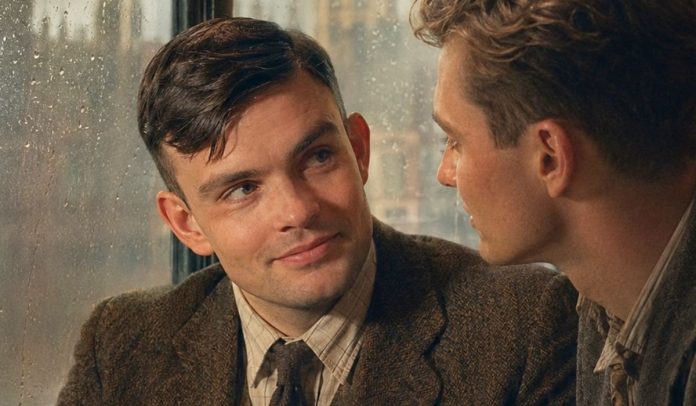

Alan Turing has often been remembered through two powerful but limiting images: the brilliant mathematician who helped Britain break Nazi codes and the persecuted gay man destroyed by the country he served.
A newly completed transcription of an unfinished story written in Turing’s own hand now reveals a personality that does not fit neatly inside either portrait.
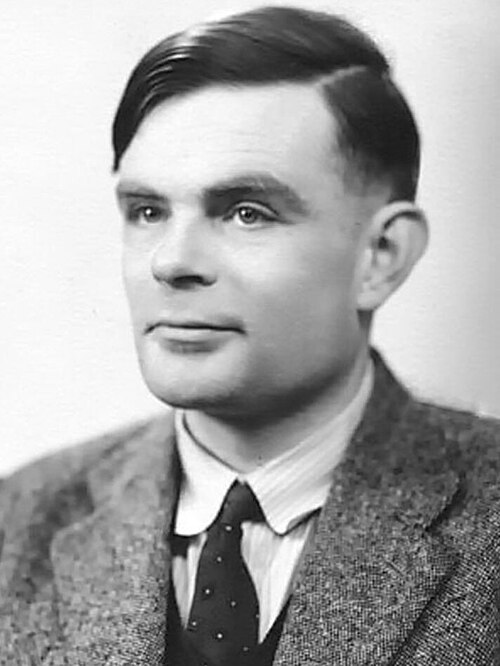
Pryce’s Buoy presents Turing as playful, funny, literary, sexually curious and far less ashamed of his homosexuality than popular retellings have sometimes suggested (Pink News).
The approximately 1,000-word manuscript survives as six handwritten pages in the archives of King’s College, Cambridge.
It has previously been quoted and discussed in part, but Cambridge literature professor Sarah Dillon has now produced the first complete transcription and extended literary study.
The story does not carry a title in Turing’s manuscript and became commonly known as Pryce’s Buoy because of the fictional invention associated with its central character.
Turing transforms himself into Alec Pryce, a successful homosexual scientist whose celebrated invention made his name while he was still a young man.
After completing another piece of scientific work he considers particularly important, Alec decides that he has earned some pleasure and goes looking for a male companion.
He encounters Ron Miller, a younger working-class man hoping to make money, and the narration moves between the thoughts of the two men as they cautiously assess one another.
The scene captures the uncertainty surrounding gay encounters at a time when consensual sex between men remained a criminal offence in Britain.
It also presents desire without apology, allowing Alec to experience attraction, self-consciousness, humour and growing comfort in another man’s company.
Dillon argues that the manuscript disrupts the two-dimensional version of Turing as a socially unaware scientist concerned only with logic and numbers.
She instead describes the writer who emerges from the pages as playful, cheeky and someone who enjoyed sex.
The story appears to be a fictionalized account of Turing’s first encounter with Arnold Murray in Manchester near the end of 1951.
Turing met Murray shortly after submitting his landmark scientific paper on morphogenesis, matching the sequence of events described through Alec Pryce.
Their relationship later became known to police after Turing reported a burglary at his home.
During the investigation, Turing openly acknowledged having a sexual relationship with Murray.
Both men were prosecuted for “gross indecency,” the same legal category used against generations of gay and bisexual men.
Turing pleaded guilty in 1952 and accepted probation that required hormonal treatment rather than imprisonment.
The estrogen treatment has frequently been described as chemical castration because of its intention and physical effects.
Turing died from cyanide poisoning in June 1954 at the age of 41, and the official inquest concluded that he had taken his own life.
The short story was probably written while he was attempting to understand what the arrest, prosecution and punishment had done to him.
In a letter written shortly before pleading guilty, Turing told his friend Norman Routledge that the strange story of how his sexuality had been discovered deserved to become a short story one day.
He also wondered what kind of person would emerge from the experience.
Dillon reads Pryce’s Buoy as part of that process of self-exploration.
Turing had always been an enthusiastic reader, including of literature dealing openly or indirectly with gay men and their social worlds.
The new study identifies a particular influence from Angus Wilson’s 1952 novel Hemlock and After, which portrayed homosexual desire, class and the largely hidden communities through which men found one another.
By turning his own experience into fiction, Turing could step outside himself and explore the encounter from both men’s perspectives.
The result is not simply confession but a glimpse of gay life in post-war England written for readers capable of recognizing that world.
It also matters because the manuscript refuses to let Turing’s sexuality appear only as the source of his suffering.
His desire is dangerous because society and the law made it dangerous, but it is not portrayed as inherently tragic.
Alec is interested in men, knows what he wants and enjoys discussing or displaying his homosexuality in company he considers appropriate.
The document therefore returns humour, eroticism and agency to a historical figure whose sexuality is too often mentioned only when describing his punishment and death.
The surviving manuscript ends abruptly at the bottom of its sixth page and in the middle of a sentence.
Its physical condition suggests that Turing probably continued writing but that the remaining pages were lost, removed or never preserved.
Dillon has questioned whether the missing section became more sexually explicit and whether someone within Turing’s family might later have censored it, although no evidence currently proves what happened.
The British government formally apologized for Turing’s treatment in 2009, and Queen Elizabeth II granted him a posthumous pardon in 2013.
Legislation commonly known as Turing’s Law later extended pardons to thousands of other men convicted under abolished laws criminalizing consensual same-sex activity.
Those acts recognized an injustice, but they could not return the years, careers and lives damaged by the law.
The new reading of Pryce’s Buoy offers a different kind of restoration.
It reminds us that Alan Turing was not only a genius, a victim or a symbol, but a complicated gay man who read, joked, desired and tried to write himself through an experience designed to shame him.
📷 AI
🎬 Prefer video? Subscribe to B-Gay on YouTube: https://youtube.com/@BGaycom