


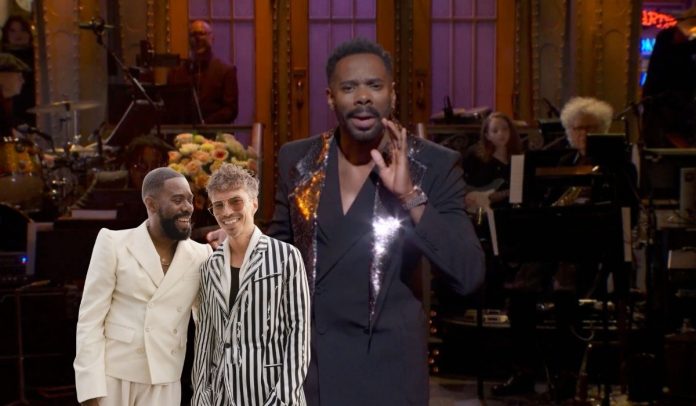

Colman Domingo made his long-awaited debut as host of Saturday Night Live, and instead of going big, he chose something far more effective.
He set a mood.
Opening his monologue with a self-aware reflection on how often he seems to be appearing across film and television, Domingo immediately showed that he understood the moment he was in.
As one of the most in-demand actors right now, his presence on the SNL stage felt less like an introduction and more like a natural continuation of his rise.
Rather than leaning into loud punchlines or fast-paced jokes, he took a more controlled approach.
He slowed things down, played with timing, and even drew attention to the lighting and music, shaping the atmosphere in real time.
The result was a monologue that felt intentional and carefully crafted.
There was humor, but it was delivered with precision.
There was confidence, but it never needed to announce itself.
While serenading the audience, Domingo joked the vibe “works for everybody” — even spotting a straight couple making out.
“Ooh, they’re straight. You don’t see that everyday,” Domingo quipped.
For audiences familiar with Domingo’s work, the moment felt like an extension of what he already does so well.
He brings depth and presence to every role, and here, he brought that same quality to a live comedy stage.
It also marked a significant moment in his career.
After decades of steady work across theater, television, and film, Domingo has entered a new phase of visibility and recognition.
His SNL debut did not feel like a breakthrough.
It felt like confirmation.
As an openly gay actor, Domingo has often spoken about the importance of authenticity in both his work and personal life.
He shares that life with his husband, Raúl, and has described their relationship as a source of stability and grounding throughout his career.
That sense of grounding was visible even on stage.
His performance carried a calm assurance that suggested not just professional confidence, but personal clarity.
Moments like this reflect a broader shift in representation, where openly LGBTQ performers are not only visible but central to major cultural platforms.
Domingo’s monologue may have been understated, but its impact was clear.
It showed that presence does not have to be loud to be powerful.
Sometimes, it is the quiet control of a moment that makes it unforgettable.