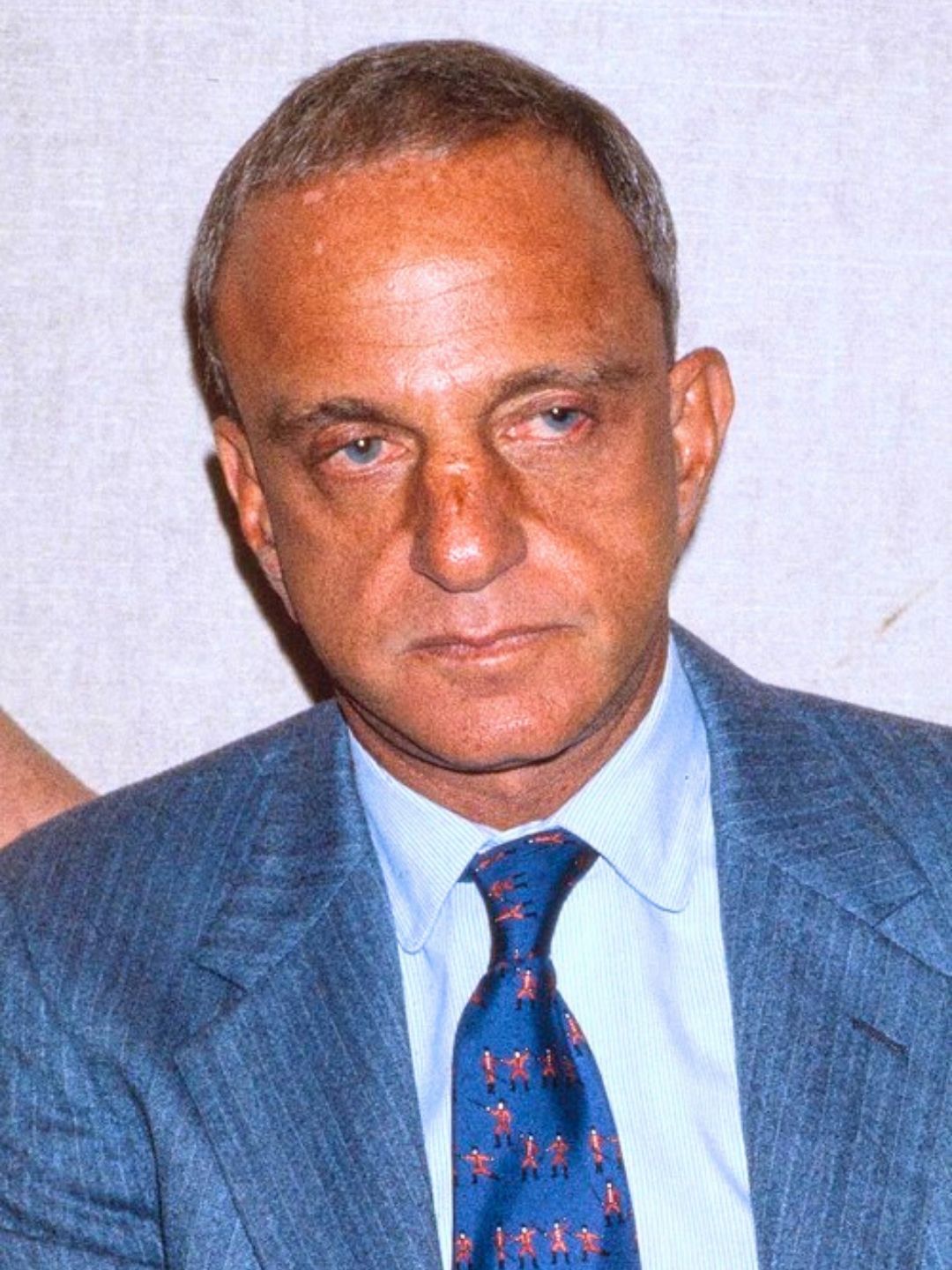
Forty years after his death, Roy Cohn remains one of the most disturbing figures in modern American political history—not simply because he lived a contradiction, but because his private reality never softened his public cruelty.
Roy Cohn died on August 2, 1986, at the age of 59.
His representatives said he had died from complications of liver cancer, but contemporary reporting established that he had AIDS.
Cohn continued denying the diagnosis publicly, just as he had always denied being gay despite extensive reporting about his relationships with men.
That denial is often presented as the final irony of his life.
But describing Roy Cohn as a hypocrite does not fully explain him.
His story is more unsettling than that.
Cohn did not merely conceal part of himself while living in an intolerant era, because he helped strengthen the political machinery that made such concealment necessary.
He turned suspicion, shame and fear into instruments of power—and used them against people whose vulnerability he understood from the inside.
The Young Lawyer Beside Joseph McCarthy
Cohn was only 26 when he became chief counsel to Senator Joseph McCarthy’s investigations subcommittee in 1953.
McCarthy is remembered primarily for his reckless hunt for alleged communists inside the United States government.
But the same period also produced another purge, now known as the Lavender Scare.
Gay men and lesbians working for the federal government were portrayed as morally weak, psychologically unstable and vulnerable to blackmail.
Their sexuality was treated not simply as a private matter but as evidence that they posed a threat to national security.
Thousands of suspected gay and lesbian employees were investigated, interrogated, dismissed or pressured to resign.
Careers were destroyed, families were devastated and some of those targeted took their own lives.
Others spent decades hiding relationships and carefully editing every part of their public behaviour.
Cohn helped advance this culture of persecution while working alongside McCarthy.
He participated in investigations that treated alleged homosexuality and alleged communism as connected dangers, helping legitimise the idea that queer people did not belong in public service.
The contradiction was already present.
During the televised Army–McCarthy hearings in 1954, insinuations about Cohn’s own sexuality surfaced publicly.
Yet there is little evidence that the experience produced empathy for the people being targeted.
Instead, he continued building a career around aggression, denial and the destruction of opponents.
Power as Protection
After McCarthy’s downfall, Cohn returned to New York and reinvented himself as a lawyer, political fixer and social power broker.
His clients stretched across business, politics, organised crime, entertainment and the Catholic Church.
He became known less for elegant legal arguments than for his willingness to intimidate adversaries, manipulate publicity and treat every dispute as a war that had to be won.
He cultivated influential friends, hosted lavish parties and made himself useful to powerful people who wanted problems solved without too many questions being asked.
Cohn appeared to understand power not merely as status but as protection.
In a society that treated gay men as weak, shameful and disposable, he fashioned himself into someone feared by almost everyone around him.
He could associate privately with men while publicly aligning himself with political and religious forces hostile to homosexuality.
He behaved as though influence could place him outside the rules imposed on everyone else.
Perhaps that is one reason his private reality never translated into public solidarity.
Cohn did not appear to imagine freedom as something people could possess together, because he understood security as something the powerful secured only for themselves.
As B-Gay has explored in other stories about LGBTQ+ history, belonging to a persecuted community does not automatically create compassion for other people facing the same prejudice.
The Mentor Donald Trump Was Looking For
In 1973, a young Donald Trump and his father faced a federal lawsuit accusing their company of discriminating against Black prospective tenants.
Rather than encouraging compromise, Cohn advised Trump to attack.
The Trump organisation countersued the federal government, accused officials of misconduct and turned the legal battle into a public confrontation.
The countersuit was dismissed, and the original case was eventually settled without an admission of wrongdoing.
But the relationship between Trump and Cohn endured.
Cohn became Trump’s lawyer, adviser and political mentor.
Accounts of their relationship consistently describe the lessons Cohn modelled: counterattack immediately, dominate the story, admit nothing and never allow an opponent to define the terms of the fight.
Those tactics are now familiar far beyond New York real estate.
Cohn understood that an accusation did not have to be disproved if it could be overwhelmed.
Bad publicity could be converted into attention, institutions could be weakened by attacking their credibility and aggression itself could be presented as evidence of strength.
His influence on Trump is one reason Cohn’s life cannot be treated merely as a dark curiosity from the McCarthy era.
The man died in 1986, but the political style survived.
The Truth He Would Not Name
Accounts of Cohn’s personal life describe relationships with men, including Peter Fraser, who was his companion during the final years of his life.
But Cohn rejected the identity that those relationships appeared to imply.
Political operative Roger Stone later described Cohn as someone who did not consider himself gay because he associated gay identity with weakness and effeminacy, while placing himself in a separate category as a powerful man who had sex with men.
That distinction reveals something important.
Cohn’s denial was not necessarily a refusal to recognise what he did, but a refusal to accept membership in a group he had learned to despise.
He could acknowledge desire while rejecting identity, community and vulnerability.
To call himself gay would have meant associating himself with people who were criminalised, mocked, fired, beaten and abandoned.
Cohn had built his entire public identity around never appearing vulnerable.
When AIDS entered his life, he approached it in much the same way he approached political accusations: deny the premise, control the narrative and attack anyone who challenged it.
He insisted that he had liver cancer.
He also used his connections to gain access to experimental treatment while many other people with AIDS were struggling to receive even basic care.
Cohn continued appearing publicly and fighting disbarment proceedings almost until the end.
Weeks before his death, New York’s highest court disbarred him for unethical conduct that included dishonesty, fraud and misrepresentation.
Even then, he portrayed himself as the victim of a vendetta.
AIDS Was Not His Punishment
There is a temptation to tell Roy Cohn’s death as a form of poetic justice: the man who helped persecute gay people was ultimately killed by an illness devastating gay communities.
That interpretation should be resisted.
AIDS was not a moral judgement, and it was not punishment for hypocrisy.
It killed hundreds of thousands of people in the United States, including activists, artists, caregivers and ordinary men whose lives were treated with appalling indifference.
The tragedy of Cohn’s ending is not that AIDS “came for him.”
It is that even as the epidemic exposed the deadly consequences of stigma, secrecy and political neglect, Cohn remained committed to denial.
The vulnerability he shared with countless other gay men did not lead him towards solidarity with them.
He continued trying to separate himself from the people dying around him.
More Than a Hypocrite
Roy Cohn’s life raises a difficult question: how can someone who belongs to a persecuted community become one of its persecutors?
There is no single answer.
Fear may have played a role, along with ambition, self-loathing and the desire to survive in institutions where homosexuality could destroy a career.
But those pressures explain only so much.
Many closeted gay people lived under the same threats without choosing to destroy other people’s lives.
Cohn repeatedly made that choice.
His story therefore should not be reduced to the familiar image of the secretly gay homophobe.
That framing can become too comfortable because it allows us to imagine that exposure alone defeats cruelty.
It suggests that revealing the hidden contradiction somehow explains or neutralises it.
Cohn’s private life did not cancel his public actions.
Nor did belonging to a marginalised group automatically make him compassionate, politically progressive or willing to defend others like himself.
What he wanted was not liberation.
He wanted exemption.
The Shadow He Left Behind
Forty years after Roy Cohn’s death, the political culture he helped shape remains recognisable.
LGBTQ+ people are still portrayed as threats to children, morality and national stability.
Political movements still turn vulnerable minorities into symbols of social decline.
Accusations are still repeated until they begin to feel true.
Institutions are still attacked whenever they threaten powerful people, and cruelty is still marketed as strength.
Cohn did not invent all of those tactics.
But he practised them with unusual discipline and passed them to people capable of carrying them much further.
That is why his story still matters.
Not because his private life offers a satisfying historical irony.
Not because his death provides a moral ending.
But because Roy Cohn demonstrated how repression can be converted into power—and how a person can spend a lifetime running from the truth while teaching an entire political culture to do the same.
Forty years later, Roy Cohn is gone, but anyone following today’s politics may recognise that his shadow never really left the room.
🎬 Prefer video? Subscribe to B-Gay on YouTube: https://youtube.com/@BGaycom