


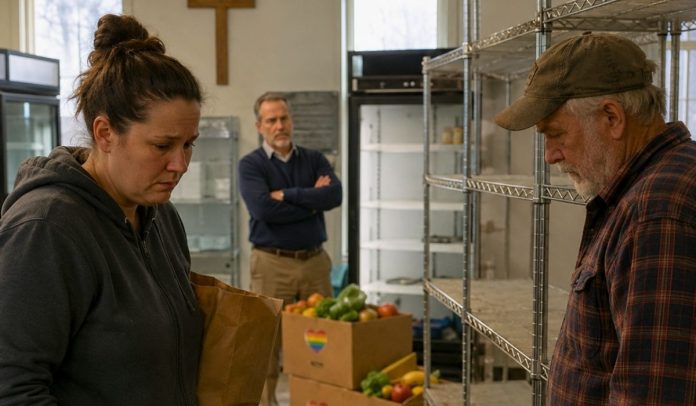

A West Virginia pastor says his food bank has been left without supplies after he refused assistance connected to organizations that support LGBTQ+ people.
Pastor Alvin Christian runs God’s Store House Food Bank in Bluefield, a small city near the border between West Virginia and Virginia.
The organization opened its local location in 2023 and quickly became a significant source of help for families experiencing food insecurity.
Local television station WVVA reported during its first year that between 500 and 800 families could attend a distribution on a busy day (LGBTQ Nation).
The food bank previously described itself as a judgment-free service that would not turn anyone away.
A recently posted video revealed that its cupboards, warehouse and freezers were now empty.
Christian acknowledged in the since-deleted Facebook Live broadcast that the shortage was connected to decisions he had made about potential food suppliers.
He said he had contacted organizations and asked whether they were connected to or partnered with LGBTQ+ causes.
After receiving confirmation that some supported LGBTQ+ people, Christian said he refused to accept their food.
He specifically referred to Feeding America, the nationwide nonprofit network that connects food banks, donors and community organizations.
Christian said he would not participate in what he called the “gay rights movement” and described LGBTQ+ inclusion as an “abomination against God.”
He presented the refusal as a religious stand he was prepared to maintain regardless of its cost.
The immediate cost, however, is being carried by people who depend upon the food bank rather than by the pastor alone.
Christian said the organization had nothing available to distribute while he searched for a supplier that met his religious requirements.
He asked supporters to pray that another source of food would become available.
At the same time, Christian insisted that he would not personally discriminate against an LGBTQ+ person seeking assistance.
He said he would love, pray for and give food to anyone who came to him.
That assurance contains an obvious contradiction when the same opposition to LGBTQ+ inclusion has helped leave the food bank without anything to give.
Christian later posted another video saying the situation had been misunderstood.
In that explanation, he claimed the food bank was not rejecting donated supplies but refusing to purchase food from organizations that might use the money to support LGBTQ+ groups.
That revised explanation does not match the way Feeding America describes its hunger-relief network.
Feeding America is a nonprofit organization that works through a nationwide network of member food banks, food pantries and meal programs.
It receives food through donations, retailers, manufacturers, farmers and other partnerships before distributing assistance across the country.
The organization does not operate as an ordinary commercial supplier selling groceries to local charities for profit.
Christian’s original video also repeatedly described rejecting food because of the organizations’ LGBTQ+ connections rather than avoiding a purchase.
The available reporting does not establish precisely which offers were made, what quantities were available or whether Feeding America directly offered supplies to God’s Store House.
Feeding America had not publicly responded to LGBTQ Nation’s request for comment when its report was published.
The pastor’s own explanation nevertheless confirms that support for LGBTQ+ people was central to his decision.
The controversy is particularly troubling because LGBTQ+ people themselves experience disproportionately high levels of poverty and food insecurity.
Research has found that many LGBTQ+ people are also reluctant to approach faith-based charities because they fear judgment, harassment or rejection.
Many religious food banks provide welcoming and essential assistance without attaching conditions to identity or belief.
Actions like Christian’s risk reinforcing the fear that religious aid may come with an ideological test.
The story also illustrates the difference between personal religious conviction and responsibility for a public-facing charitable service.
Christian is entitled to his theological beliefs and to express opposition to LGBTQ+ rights.
But a food bank exists to collect resources and transfer them to people who need help.
Rejecting safe food because someone involved supports gay or transgender people does nothing to reduce hunger or protect Christian doctrine.
It turns donated groceries into symbols within a political conflict they were meant to bypass.
A box of cereal does not endorse marriage equality, and a can of vegetables does not carry a gender identity.
The families arriving at God’s Store House are unlikely to care whether the person who donated their dinner attended Pride or supported an LGBTQ+ colleague.
They care whether there is enough food to take home.
Christian has said he hopes faith will lead him to a new source of supplies.
That may eventually happen, and the food bank could reopen its distributions.
Until then, its empty shelves demonstrate the practical consequences of placing religious purity above cooperation.
The pastor may consider the refusal his sacrifice, but the people leaving without groceries are the ones being asked to pay for it.
📷 AI
🎬 Prefer video? Subscribe to B-Gay on YouTube: https://youtube.com/@BGaycom